In the developing world, undernutrition remains an import cause of illness and death in children.
Wasting
Wasting is a more acute form of undernutrition, resulting in a child that’s too thin for it’s age. Wasting is life threatening, because of weakening of the immune system and thus susceptibility to many diseases. Although the acute danger, wasting is reversible by rapid feeding and care.
Stunting
Stunting is a form of undernutrition where a child is too short for his/her age. This stunting is the result of insufficient nutrition for a longer period of time in-utero or early childhood. Cognitive and physical damage may be irreversible and the child may never reach his/her full potential.
Globally
In 2018, 49 million children under 5 worldwide were wasted (7.3% of all children under 5). 28% of those children lived on the African continent.
In 2018, stunting affected 149 million children under 5 worldwide, which is 21.9% of the total. Africa was responsible for 39% of these cases.
East Africa
Let’s move to East-Africa and be even more exact: the prevalence of wasting in East-Africa was 6.0%. This is, except for South-Africa, the lowest prevalence compared to the rest of Africa. This may sound as good news, but still the lives of 4.1 million children under 5 are affected by this form of undernutrition.
The numbers of stunting are even more severe. East-Africa has the highest prevalence of stunting in the world: 35.2% of all children under 5. Moreover, the number of stunted children didn’t decrease in the past decade in this area. The total amount of children under 5 who were stunted, increased from 21.5 million in 2008, to 24 million in 2018.
Can we solve this problem?
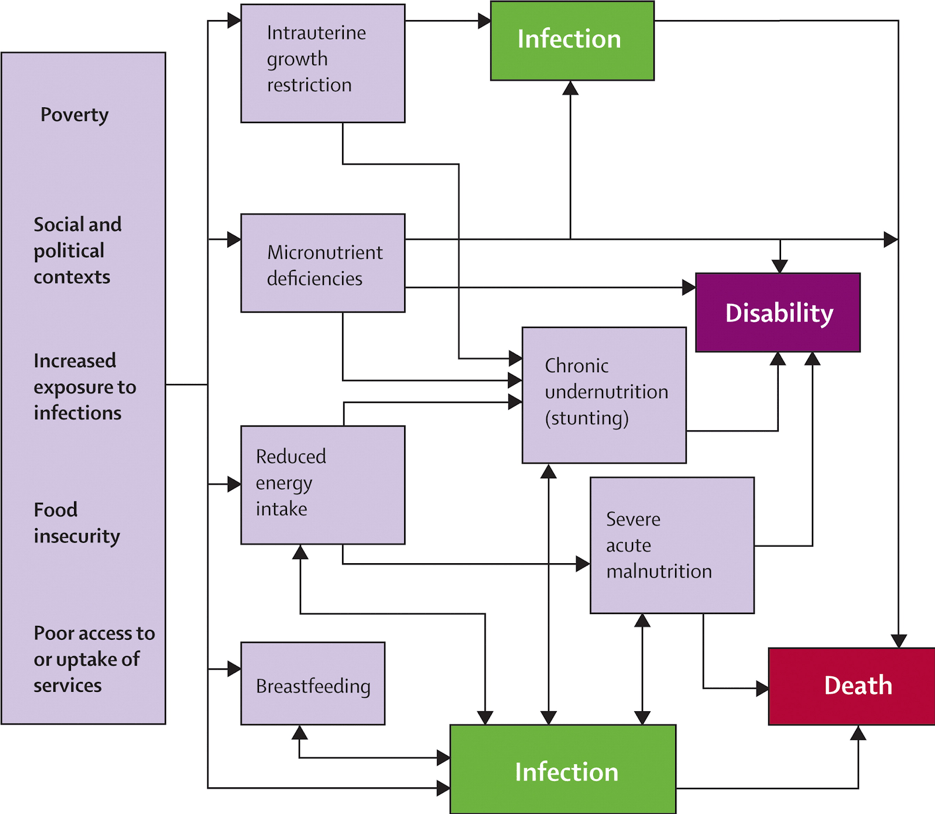
Scientific research estimated that in 2011, undernutrition was responsible for 3.1 million child deaths globally, which is 45% of all child deaths this year. It is clear undernutrition needs to be addressed, and multiple interventions are possible, targeting different aspects of the problem. The figure below shows the framework of undernutrition, with how and why it can lead to death and disability. Research of the Lancet investigated several interventions and their effectivity in decreasing undernutrition and it’s consequences.
According to the research, the most promising interventions regarding child survival include
- counselling about breastfeeding
- fortification or supplementation with vitamin A and zinc in the child.
If these effective interventions are implemented at sufficient scale, DALY’s due to child deaths could be reduced by a quarter in short term.
Regarding to stunting, the most promising interventions include
- Counselling about nutrition in food-secure populations
- Provision of food supplements (with or without education) in food insecure populations.
Both methods increased the height-for-age score in observed populations.
To reduce the risk of low birthweight with 16%, it is effective to give pregnant women supplements with iron folate and micronutrients. This interventions also improve maternal health.
Unfortunately, implementing these short term interventions won’t be enough since they do not address the underlying determinants causing undernutrition. These determinants include poverty, poor education and lack of empowerment of women. With both long and short time investments, undernutrition can decrease significantly and hopefully, one day won’t exist anymore.
Sources used:
– https://www-sciencedirect-com.vu-nl.idm.oclc.org/science/article/pii/S014067361360937X
– https://www-sciencedirect-com.vu-nl.idm.oclc.org/science/article/pii/S0140673607616936
– http://www.sajcn.co.za/index.php/SAJCN/article/view/1399
– https://www.who.int/nutgrowthdb/jme-2019-key-findings.pdf?ua=1
 East Africa
Dear group, I enjoyed reading one of the first posts of your blog about undernutrition. I have a question about one of the interventions recommended by current research to reduce stunting: counselling about nutrition in food-secure populations. Does this mean that in families who do have enough food, children are still stunted? What could be the reason for this? Does this mean they are not using their food well? E.g. because of a lack of variety? Or are there micro-nutrient deficiencies?
Kind regards,
Lisa Kolodziej
LikeLike
Thankyou for your question! This is indeed a problem in many countries. Caregivers might not be aware of right amounts of food to give their children, or don’t give them the right kinds of food. This is often due to wrong advice and lack of knowledge. Further, cultural beliefs and practices may cause inefficient use of foods. Easy advice and lessons can therefor make a big differences in the problem of stunting in children in food-secure areas.
LikeGeliked door 1 persoon
I liked the exploration of underlying causes for malnutrition, and the various health outcomes for children that are suffering from undernutrition. It would be interesting to learn more about the exact connections of undernutrition and communicable diseases, and how big that influence/connection is in Eastern Africa!
LikeLike
Thank you for your comment! It is indeed interesting to have a look at this connection. In the meantime we uploaded a blogpost about the double burden of undernutrtion and obesity, this blog will partly answer your questions! If questions still do exist, do not hesitate to place a comment over there
LikeLike
Hi,
I want to say first that I found the piece of work interesting to read! I think you have explained the types of malnutrition well (and the difference between them). But aren’t there also 2 other forms of undernutrition? Or were these other forms not relevant to you, because that is possible of course. I read on your homepage that your target group is ‘the public’. I don’t think everyone knows what a ‘DALY’ is. My tip to you therefore is to explain the abbreviation. A top is that you have used a figure in your post, which gives a good overview. Keep up the good work!
LikeLike
We’re glad you liked the blogpost. Stunting and wasting are the two forms of under nutrition that are most relevant according to WHO rapports, that’s why they are discussed here. The tip about the definition of a DALY is helpful, it is indeed important to make sure everyone can understand our posts. We will adjust this!
LikeLike
Very interesting and clear blogpost! The information about stunting and wasting seems very structured and complete. However, wouldn’t it be important to go a little more into the determinants that cause the interventions to not be a total success? Since it seems like it has a big impact on the process. Or perhaps add results of the interventions that already have been taking place. But all in all very clear and structured!(:
LikeLike
Thanks for your feedback! In order to not make things to difficult, we thought it would be best to stay in the more general area, but we will consider to maybe go a bit deeper and really review interventions. However it is hard to really dive into the underlying determinants, since lack of education and money are not something you analyse in a few sentences.
We consider and appreciate your comment
LikeLike
Hello all,
I love the way you set up the information in this blog post by separating the topics and then following up with the interventions that can be used to prevent these conditions from happening. I did not know how many children worldwide were affected by undernutrition, and the number is most likely increasing due to a variety of health determinants. I am curious if you have any suggestions for interventions that were not listed.
I look forward to following along with future posts!
Emily McDowell
LikeLike
As briefly mentioned in the post, the interventions related to supplementation are mostly short term solutions. Of course these interventions can safe lives, but won’t really solve the problem. However it is hard to really solve the determinants. Another prevention method not listed could be monitoring children, and like this know early when a child is in an early stage of under nutrition. To really solve the problem, a lot of money should be available and a multisectoral plan should be made.
LikeLike
Hi everyone,
Even though I think you blog looks really really beautiful (compliments on that), to my opinion, this blogpost is a bit ‘static’. The information you give, especially in the first part of the blog when you’re talking about stunting, wasting, globally and East Africa, isn’t written that nicely and smooth. To my opinion you can make more of a story out of it, give more details or write more extensive. Right now, it is just a sum up of the definitions, which is not that nice and interesting to read.
Moreover, I was wondering what you want to accomplish with this blog post. Of course the information you give is interesting and it is important to know what the situation regarding undernutrition in East-Africa is.
But your blog is written for the general public of East Africa, right?
Do you think it is interesting for them to read about possible interventions? What can they do with that information..?
Really try to remember who your audience is and right in a way that is interesting for them (the same applies for the fact that you say: “A reserach from Lancet” …)
Kind regards,
Eva Feijt
LikeLike
Dear group,
I was surprised that you placed ‘undernutrition’ as subtopic of communicable diseases, so I hoped that you would declare this in the blogpost. Unfortunately, after reading it is still not clear to me.
In your definition of wasting you name a child being too ‘thin’ for its age’. But doesn’t it used to be ‘a too low weight for height?’
Maybe it is nice if you add a map of the wasted and/ or stunted population around the word (tip: check ‘our world in data’, they have a lot of nice graphs and maps).
My compliments for the figure with the framework of undernutrition. Did you make it yourself or found it online?
Regards,
Tharsini
LikeLike